Blog

  • Guide to making a home insurance claim

    Guide to making a home insurance claim

    It is reassuring to know what to do if something does go wrong and you have to make a claim on your house insurance.

    This short guide aims to help and inform so that the process of making a claim is as smooth and swift for you as we can possibly make it.

    So that you are best prepared in the event of an accident, the first thing we would suggest is to add the A-Plan telephone numbers to your phone contacts. Your branch number can be found here. If it is out of office hours, you will find some helpful claims information here.

    Home Guide

    What to do if you need to make a claim?

    If during working hours, please contact your A-Plan branch as quickly as possible. Our friendly and understanding advisers will be keen to help you.

    Where urgent out of hours help is needed, please contact your home insurer directly on the claims helpline number which will be found in your policy documentation. You can also find a list of claims helplines here. You will need to provide your policy number and some details of when and where the problem occurred and what damage has resulted.

    If you are unable to make contact with your insurer (for example, during exceptionally busy periods) you may wish to arrange your own contractor to carry out the initial emergency repairs – please keep receipts to assist with recovery of these costs from your insurer (where the policy includes cover).

    In any event please call your A-Plan branch as soon as you are reasonably able to do so and we will help guide you through the process.

    Theft/Loss of property and malicious damage

    Following a theft, attempted theft or loss of property, report the incident to the police as soon as possible and get a crime reference number or loss report number which will be required by your insurers. The same applies to any malicious damage or vandalism.

    Emergencies

    If you have purchased optional home emergency cover (through DAS) the helpline number is 0800 032 3867.
    In the event of a fire at your property (however minor) please call the emergency services as soon as it is safe and possible to do so.

    If you smell gas call the National Gas Emergency Service on 0800 111 999.

    You can also use this number to report a gas or carbon monoxide emergency, or if a pipeline is struck (even if no gas leak has occurred).

  • Temporary Van Insurance

    At A-Plan, we understand that there are some situations when you only need van insurance for a short period of time – days, weeks or months – rather than taking out van insurance for a whole year. You might be a business that only uses a van for the occasional job, or you could be using a van privately for a couple of days to move house, or to take rubbish to the tip. Temporary van insurance gives you the flexibility to insure a van for when you’re actually using it, saving you money on a full-year policy.

    As one of the UK’s largest van insurance brokers, we work with a number of specially chosen van insurers to bring you the best deals on a range of temporary van insurance policies. Not only do you have the peace of mind that your van is protected with the right insurance cover, but you also have the reassurance that our fast claims service will ensure your van won’t be off the road for long in the event of an accident.

    How to get temporary van insurance

    When you shop around for temporary van insurance quotes, don’t forget to read the details of each policy carefully to ensure that it covers your intended use of the van. There are different policies for private, retail and trade van drivers, so you’ll need to make sure that you select the right one for your needs. Alternatively, give us a call and we’ll do the hard work of comparing policies for you.

    Whether you’re a private or commercial van user, you have the option of adding breakdown cover onto your temporary van insurance policy for extra peace of mind, so you don’t have to take it out for a full year. If you’re a business van driver, you might also want to bolt on extra cover to insure your tools or goods in transit.

    Contact us today to talk to one of our expert van insurers and get a quote for temporary van insurance that meets your needs – and your budget.

  • New for old static caravan insurance explained

    New for old static caravan insurance explained

    Like cars, static caravans will tend to lose value in their first year and continue to depreciate in value thereafter. That shouldn’t put you off though; they are a fantastic investment for those who want to know they have a home from home to escape to at a moment’s notice.

    So how do you ensure your investment is protected?

    When it comes to your insurance for your static caravan, there are usually two main levels of cover offered by insurance companies. The first is market value cover which does what it says on the tin and offers you the current market value for your static caravan at the time of an insured loss.

    New for old insurance, on the other hand, is designed to provide you with a brand new, equivalent replacement of your static caravan should your caravan be damaged beyond repair by an insured peril such as fire or flood. Because you are insured for a replacement as new, you must therefore consider what the current cost of a like-for-like, or equivalent model will be.

    There are a few of ways that you can find this out:

    • Check with the manufacturer – You could do this online (making sure that the page you are looking at is the most up-to-date) or give them a call.
    • Asking an independent, advice-giving broker like A-Plan to check in the up-to-date Glass’s Guide for new-for-old replacement costs.
    • Your park manager may also have an up- to-date Glass’s guide.

    The other aspects to consider are your contents, decking, re-siting and clearance costs. These should be included in your insurance quotation if required. By choosing to insure your static caravan and decking, if you have it, on a new-for-old basis you may find that the contents of your caravan are automatically insured on a new-for-old basis too, though it’s worth checking just to be sure. You should also check the value of your contents as new so if you need to replace them in a claim situation, you have the correct sums insured.

    Lastly, remember that prices do tend to go up year-on-year so it’s worth reviewing the figures on your insurance documents to ensure that you have the correct up-to-date amounts there each year.

    If you have any queries regarding market value cover, or new-for-old cover, or would like a quotation for your static caravan insurance, please call our A-Plan static caravan team members on 01527 879777.

  • Health & Safety – Testing Electrical Equipment

    Health & Safety – Testing Electrical Equipment

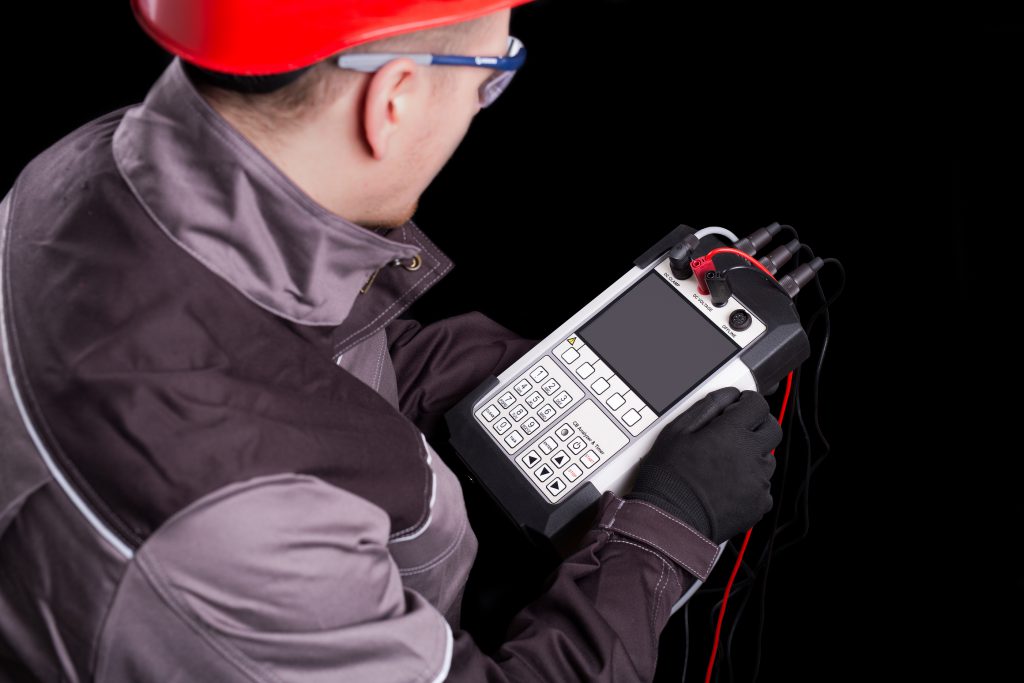
    Electrical testing is a critical maintenance task that ensures that key equipment and systems in your business are operating efficiently year-round. Specifically, electrical testing may be carried out for several reasons, such as:
    • Quality assurance tests on electrical components
    • Diagnostic testing
    • Fault finding on electrical plants
    • Routine safety checks

    There are also legal requirements around testing…

    The Law
    The main pieces of legislation relating to electrical-testing activities are:
    • Electricity at Work Regulations 1989: Regulation 4(3) requires that work on or near an electrical system ‘shall be carried out in such a manner as not to give rise, so far as is reasonably practicable, to danger’. Regulation 14 places a strict prohibition on working on or near exposed live conductors unless:
    • It is unreasonable in all circumstances for it to be dead
    • It is reasonable in all circumstances for the work to take place on or near the live conductor
    • Suitable precautions, including the provision of suitable protective equipment where necessary, have been taken to prevent injury
    • Management of Health and Safety at Work Regulations 1999: Requires that a suitable and sufficient risk assessment is made

    Risks Associated With Electrical Testing
    There are several risks associated with carrying out electrical testing and injury can occur when:
    • Live electrical parts are exposed and can be touched
    • Metalwork that is meant to be earthed becomes live at a dangerous voltage

    It is more likely that this will happen during electrical testing and fault finding, when conductors at dangerous voltages are often exposed. You can minimise this risk if testing is done while the equipment is isolated from any dangerous source of supply, although this is not always possible. Take care to prevent contact with any hazardous internally produced voltages.

    The most serious injuries are caused by electric shock. The effects of a shock are largely unpredictable and can easily lead to a fatal injury. However, there is also a risk of burn injuries from arcing when conductors are accidentally short-circuited. Another risk can be caused by a person reacting to an electrical injury, such as falling from an access ladder or being traumatised by the experience.

    Carrying Out a Risk Assessment
    You must carry out a risk assessment before testing begins, to help you identify the measures to take. Consider the following when assessing the risk of injury from electrical-testing work:
    • The level of voltage, charge or current
    • The nature of the environment

    Managing Electrical Testing
    You must provide a safe working environment and establish a safe system of work for your employees. The results of your risk assessment will help to identify the steps you need to take to do this. Employees must cooperate and take reasonable care for their own and other people’s safety while they are at work.

    Protecting the People Doing the Testing
    You must put effective measures in place to protect the people doing the testing, in order to prevent them from coming into accidental contact with dangerous exposed conductors. This might be either a single-hand contact with a source of energy which has one of its supply conductors connected to earth, or another area of conducting surface.
    Class I equipment is in this category because the mains at source are earth-referenced; so is electronic equipment where a large metal surface (or chassis) is connected to the source. There is also a risk of injury from sources of supply which are not earth-referenced and where accidental simultaneous contact with both poles of the supply is possible.

    Choosing Test Equipment
    Where possible, test equipment should be of a proprietary design. In this case, the manufacturer should have taken an account of its safety performance during use. Where applicable, test equipment should be manufactured to BS EN 61010.

    Ensuring Safe Systems of Work
    Details of safe systems of work for testing activities should, wherever it is reasonably practicable to do so, be documented. To produce a workable system, all personnel should be involved in preparing the safe systems of work. The completed documents, which will need to be reviewed from time to time, should be made readily available to employees.

    Training
    All personnel involved in testing should be given specific safety training that is relevant to the work they are doing. Appropriate training or instruction must also be given to anyone who may attempt to enter test areas and approach test benches.
    You are likely to need to provide new training whenever any of the following changes take place:
    • Product design, layout and installation
    • Production or working methods
    • Test methods and instruments
    • Test personnel and others who may be affected
    For further advice regarding the requirements for health and safety at your business please contact your local commercial branch

  • Security devices for your touring caravan

    Security devices for your touring caravan

    Naturally you’ll want to take care of your caravan and protect it from risks like theft. In addition, most insurers will require some form of security device to be fitted to your caravan before they agree to cover it. So what’s what in the world of caravan security? We’ll run through the main security devices available to protect touring caravans and explain when you’re most likely to need them.

    Hitch locks

    Hitch locks are often required by an insurer as a minimum security requirement. It’s a metal box designed to fit over the coupling head while the caravan is stationary. Once locked, the box pushes a ball into the coupling head so it is lodged in a way which makes it virtually impossible to hitch onto the tow bar. This is handy when your pitch up your caravan on a park and go out for the day or when you stop at service stations. There are a variety available so do check which is best for your caravan.

    Wheel Clamps

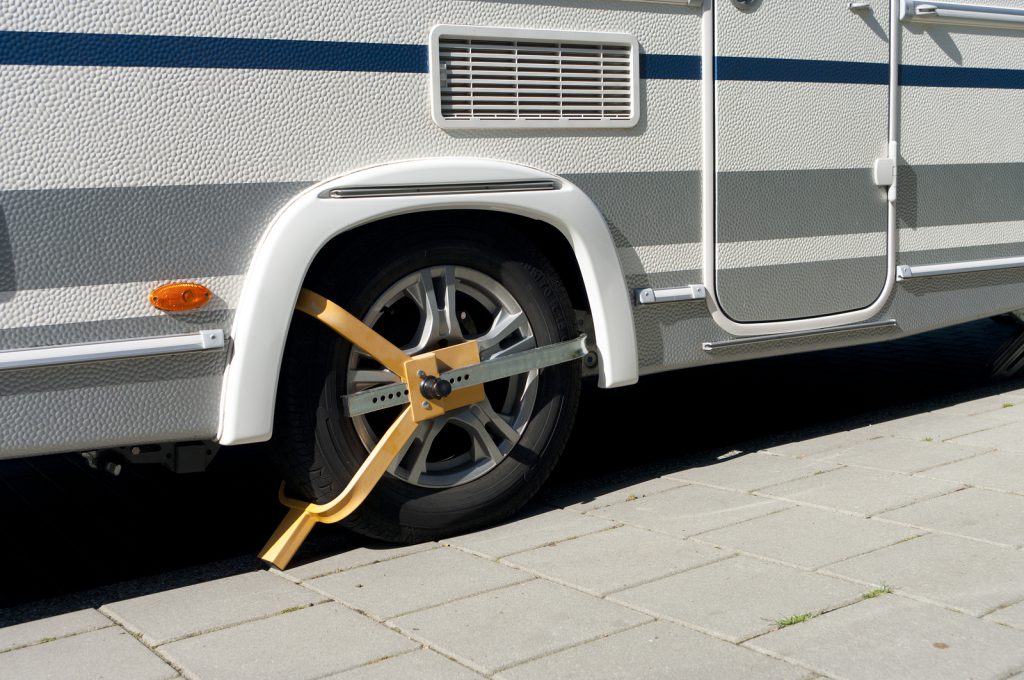
    Wheel clamps are another device that are usually required as a minimum security measure when you’re insuring your touring caravan. They come in many shapes and sizes but they all essentially do the same thing. Wheel clamps encase the wheel and prevent them from rotating. You simply tighten the clamp over the wheel using bolts then attach casing to enclose the bolts with a second set of casing so they are inaccessible. Like with hitch locks, you should check the wheel is suitable for your caravan. Some are not suitable for alloy wheels but a quick Google search should help you establish if you’re looking at the right device.

    Anchoring Device

    An anchoring device literally anchors into the ground and embeds itself there making it very difficult for the caravan to be towed away.

    Hitch Posts

    You might find these at some parks and storage locations as an extra security measure and they are often used to keep private parking spaces private. Hitch posts are concreted into the ground and can be lifted once your caravan is in parked up so the caravan is blocked in. If you store your caravan on your driveway at home this is a good measure to take both as a visual deterrent and a physical barrier.

    Chassis Secure Wheel Lock

    These are quite different to wheel clamps. Rather than encasing the wheel to restrict movement, a wheel lock goes through the wheel and locks onto the chassis of the caravan.

    For higher value caravans, you may find insurers requesting more security and a wheel lock can be a good solution. Just make sure you check which wheel locks are accepted by your insurer.

    Pro Active Tracking devices

    This method may seem like it only helps if your caravan has already been stolen but in fact thieves who spot a sticker or logo for a pro-active tracker will probably think twice before attempting to take your caravan.

    A unit will be hidden inside the caravan and track the caravans whereabouts using GPS. Some models will even text you if your caravan has moved so you can alert the police straight away. Most companies who provide pro-active tracking devices will also come out and fit them for you too.

    For more information on touring caravan insurance or to obtain your quotation from us, please contact one of the members of our caravan team at A-Plan Bromsgrove on 01527 879777.

  • Permanently Siting Your Touring Caravan

    Permanently Siting Your Touring Caravan

    There are plenty of reasons why permanently siting your touring caravan can be appealing. For one, you may have found a site which you love enough to visit every time you go away or it may be that you no longer wish to be on the road with your caravan. Either way, it’s certainly something worth considering.

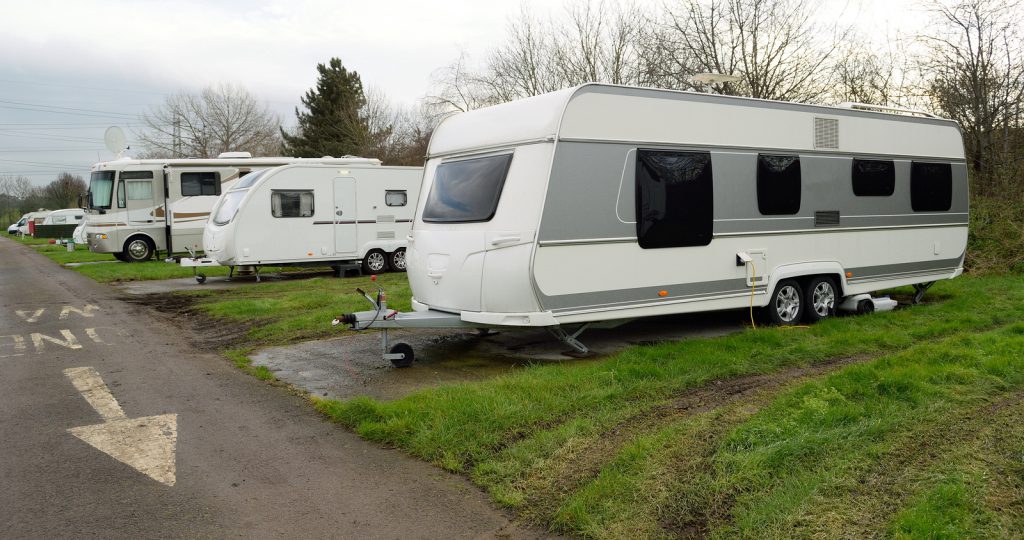
    Permanently sited caravans are those which are no longer towed and therefore you may wonder whether it’s worth insuring them at all. Though it can be considered safer to site your caravan, as you are avoiding the risk of collision on the road, there are still other risks which could cause damage to your caravan.

     So what should you look out for when insuring?

    Firstly, you might find that your chosen holiday park requires you to have public liability insurance. Public liability insurance covers your legal responsibility to reimburse third parties for damage you may cause to them or their property through negligence related to your caravan.

    Though there are varying amounts you can purchase depending on the insurer you choose, you’re generally required to have a minimum of £2 million public liability cover. Always check with the park manager or owner to confirm before you purchase your insurance, then you know you’ve got the right amount in place.

    Fire and theft are also considerations, no matter how safe the site you have chosen, a fire could still occur and have devastating effects on your caravan. Theft is something you can help prevent using various security devices that are available on the market but it’s still worth taking the precaution of having theft cover in place. It’s a fairly standard cover on most caravan insurance policies but do consider how much your caravan is worth along with how much your content would cost to replace before calling your insurer.

    So if you are buying a more basic insurance policy you should be careful to check that storm cover is included. A caravan, though sited, may still suffer the effects of a significant storm especially if you have an awning. Similarly, you should look out for accidental damage cover when choosing your policy. You may think accidental damage is only likely to occur from bumps and scrapes on the road but in reality there are many ways accidental damage can be caused to your caravan. It could be that you damage the interior while cooking or, you scrape the side while setting up or taking down your awning.

    Some insurance companies will provide a discount to caravans which are permanently sited to it’s certainly worth investigating what’s available.

    If you have any questions about choosing a permanent pitch for your caravan and the insurance you will require please contact the A-Plan specialist team in Bromsgrove.

  • How telematics insurance can help young drivers

    How telematics insurance can help young drivers

    Why is telematics also known as Black Box insurance?

    Telematics involves a black box being fitted to your vehicle which uses satellite technology to assess speed, braking, acceleration, cornering and the time of day journeys are made. Some telematics or black box insurance policies also operate a curfew with an excess premium charged if the car is used during dangerous night-time hours.

    The data is transmitted to the insurance provider by GPS and the company can tell how likely a driver is to make a claim.

    Drive IQ, a site which offers a platform of online tools designed to help young drivers, expects that one in four car insurance policies will be telematics based by 2020, while the British Insurance Brokers’ Association (BIBA) suggests that sales of black box insurance policies have increased five-fold in the past two years and are expected to reach 500,000 in the next two years.

    Why is this telematics important for young or new drivers?

    Telematics helps insurers rely on real data rather than proxies in order to price insurance premiums, resulting in more accurate prices and risk calculation. It also helps insurers to reduce claims costs, to enable lower premiums and to fight fraud.

    There are also benefits for personal lines and commercial insurance customers through reduced motor insurance premiums, fuel savings, value-added services (such as instant emergency services response and young driver monitoring), as well as through the ability to monitor and improve driver safety.

    How can telematics insurance help young drivers?

    Telematics insurance is particularly advantageous for young drivers who may find it difficult to get affordable cover – and in some cases, to get cover at all. This is because insurers calculate policy costs according to statistical risk and many insurers deem young motorists too high a risk based on accident statistics. For example, Association of British Insurers (ABI) shows drivers between 17 and 24 are three times more likely than other road users to be responsible for “catastrophic claims”.

    As the technology works by recording driver behaviour, premiums can be more accurately calculated based on the young driver’s individual risk rather than that of their risk group, allowing safer young drivers to pay lower premiums.

    With more affordable cover in place, this allows young drivers to build up their valuable no claims bonus as soon as possible which also works towards a more affordable policy for them in the future.

    How can A-Plan help?

    A-Plan offer Young Driver Telematics Insurance through our relationship with Marmalade Insurance Ltd.

    With Marmalade, a black box is fitted to your car which is a simple procedure. Unlike some other companies, however, there are no restrictive curfews or negative night-time driving penalties. Young drivers can drive when and where they want to. Once in place, the technology feeds back information on how safely the young driver is driving by measuring acceleration, braking, cornering and speed. This feedback is available online instantly on every journey through a web based portal which also features handy eLearning modules to help become even safer.

    Please speak to our Oxford branch for more information or to obtain a “Quick Quote” by answering just 3 questions. Call them today on 01865 241441

  • The 12 days of insurance at Christmas

    The 12 days of insurance at Christmas

    In keeping with the festive mood, may we present “The 12 days of insurance at Christmas”….

    On the first day of insurance at Christmas, A-Plan gives to you an interesting fact about the most expensive car insurance claim to ever be made in the UK. Did you know that it was made by Rowan Atkinson of Mr Bean and Blackadder fame? Rowan Atkinson sustained a minor shoulder injury when he crashed his McLaren F1 supercar after hitting ice in 2011. This was the second time Rowan had crashed his car which he bought in 1997 for around £540,000. Despite the injury only being minor, this was believed to be the biggest car insurance claim in the UK at close to £1m. Rowan then went on to sell the car earlier this year for £8m! One careful owner?

    On the second day of insurance at Christmas – a question for you!
    Who pays more for their car insurance – a 30 year old or a 90 year old?

    On the third day of Insurance at Christmas – did you know?
    Iceland’s most costly volcanic eruption took place in the Easter holidays of 2010. Mount Eyjafjallajokull erupted and although, luckily, no one was injured, it still cost the EU over €2.5 billion, according to the EU Transport Commission. This volcanic eruption released massive ash clouds which drifted southwards towards the Atlantic and Europe causing hundreds of flights to be cancelled and stranding over ten million passengers. The volcanic eruption also caused domino effects on EU’s economy: It created a no fly zone over a significant area of Europe, which also had an impact on many international airlines based in Asia and the US. The global price of airline fuel also dropped as a result of flights being grounded.

    On the fourth Day of insurance at Christmas – a question for you!
    Which is the cheapest location for car insurance – Liverpool, Manchester or Croydon?

    On the fifth day of insurance at Christmas – did you know?
    In about seven hours in 2003, ten million people living in Canada, and 45 million living in the US, all suffered a severe widespread power blackout. The overall cost of the power outage was estimated at $6 billion. While there are some conflicting estimates on the cost of the insurance claim, it’s widely acknowledged that the pay-out for the grounded flights, looting, business interruptions and other such problems puts this incident firmly on the list of most costly insurance claims ever!

    On the sixth day of insurance at Christmas – a question for you!
    Which type of insurance is more expensive for a 20 year old – fully comprehensive or 3rd party?

    On the seventh day of insurance at Christmas – a tip
    Don’t leave branded cardboard boxes on display by your dustbins around the Christmas period – you are just advertising to potential thieves that these goods are now in your house. Either keep them out of sight till the first refuge collection, or break them down and put them in your recycling box,

    On the eighth day of insurance at Christmas – a bizarre Christmas-related insurance claim!
    Mr Fairclough was driving home from Christmas shopping, when he saw a car coming the other way with a Christmas tree badly tied to its roof. This must have been a split second observation: no sooner had he seen it than the tree launched itself straight at him.

    “He was driving too fast around a sharp bend and I saw the tree lift off and it flew straight at me. The trunk made a great dent in my bonnet and caused me to swerve off the road into a hedge.” Mr Fairclough added: “The chap didn’t stop and he never came back for his tree, so the Police said we might as well have it”!

    On the ninth day of insurance at Christmas – how to stop burglaries!
    One in three households spending Christmas away from home is likely to follow the example of Macaulay Culkin in Home Alone and set booby traps for burglars. Typical precautions include positioning cardboard cut-outs or dummies behind netted curtains, icing steps and greasing doorknobs. Ironically, such efforts are seldom necessary: Christmas Day has 55% fewer burglaries than the average day, with thieves also taking a break to enjoy the festivities.

    On the tenth day of insurance at Christmas – did you know?
    Lloyds of London was the first to issue a policy covering Santa Claus.  This isn’t a policy for Santa that you see in your local shopping centre – this is the real deal. Proof for any non-believers out there! “The personal accident policy covers Mr. Claus until the 25th of December in the event of accident and illness, in the run up to, and during his worldwide travels to deliver presents to good children.”

    On the eleventh day of insurance at Christmas – the last of our quiz questions
    Are you automatically insured to drive other cars if you have a comprehensive policy?

    On the twelfth day of insurance at Christmas – did you know?
    Today’s cost to buy your “true love” all the gifts in the 12 Days of Christmas would be an estimated £15,500.  Moreover, Insurance Journal estimates that it would cost 20 times as much to insure (£310,000/year for the insurance for livestock mortality, equipment breakdown, inland cargo, workers’ compensation and a special policy for all the gold rings)!

    Answers to the quiz questions will be revealed on our Facebook and Twitter pages over the coming weeks

    Sources: www.lloyds.com, www.seanpaulins.com, www.theguardian.com, www.listverse.com, www.bornrich.com, www.moneymatterstome.com, www.carmagazine.co.uk
  • Drivers’ Hours Guidelines – A Summary of Rules for Commercial Drivers

    Drivers’ Hours Guidelines – A Summary of Rules for Commercial Drivers

    The Department for Transport (DfT) and the Vehicle & Operator Services Agency (VOSA) enforce the rules that govern the number of hours drivers of commercial motor vehicles (CMVs) can spend on the road. In order to decide which rule applies to a specific driver, one must look at the location, weight and the nature of the driving.

    Most commercial drivers in the UK will be governed by one of three main sets of drivers’ hours rules: the European Union (EU) rules, the Great Britain (GB) domestic rules or the European Agreement concerning the Work of Crews of Vehicles engaged in International Road Transport (AETR) rules. Within Great Britain, either the EU rules or domestic GB rules may apply. For international journeys, the EU rules or AETR rules may apply. Keep in mind that Northern Ireland operates its own set of drivers’ hours rules.

    Some drivers will be subject to multiple rules during a given day or a week depending on what countries they are driving through. These drivers must comply with all relevant requirements for rest periods and breaks.

    • Driving Limits
      • Drivers may drive no more than 9 hours a day. This limit may be extended to 10 hours twice per week.
      • Drivers may drive no more than 56 hours in a single week. This applies to a fixed week, which starts at 00.00 on Monday and ends at 24.00 on the following Sunday. Employees may not exceed 90 hours of driving time in any two-week period.
    • Break Periods
      • A break is any period during which a driver does not drive or perform any other work and which is used exclusively for recuperation. A break may be taken in a moving vehicle, provided no other work is undertaken.
      • Drivers must take a break of at least 45 minutes for every 4.5 hours driven. The break can be split into two periods, one of at least 15 minutes followed by one of at least 30 minutes. Drivers cannot split breaks into three periods of 15 minutes.
    • Rest Periods
      • Rest refers to an uninterrupted period away from work duties. Time spent working in other employment or under obligation or instruction, regardless of the occupation type, cannot be counted as rest.
      • Daily Rest
        • Drivers must take a daily rest period. The regular daily rest period is 11 consecutive hours (or more) of rest, but daily rest can be reduced to 9 hours up to three times between any two weekly rest periods.
        • The daily rest can be broken up into two periods totalling 12 hours; the first must be at least 3 hours, the second must be at least 9 hours.
      • Weekly Rest
        • Drivers must start their weekly rest period no later than at the end of six consecutive 24-hour periods since their last weekly rest.
        • A regular weekly rest period is 45 hours. However, a driver may take a reduced weekly rest period of at least 24 consecutive hours. In any two consecutive weeks, the employee must have at least two weekly rests—one being at least 45 hours long.
        • If a driver takes a reduced weekly rest, he or she must compensate for the reduced hours in an equivalent period of rest, in one block, before the end of the third week following the reduced weekly rest. The compensated rest period must be attached to another period of rest of at least 9 hours.
      • Recordkeeping Requirements
        • All vehicles must have an approved tachograph to record drivers’ hours. If a digital tachograph is installed, drivers must use a personalised driver card. The driver must produce tachograph records upon request for the current day and the previous 28 calendar days in which he has driven under EU/AETR rules.
      • Drivers normally subject to the EU rules also have to comply with the Road Transport (Working Time) Regulations.

    UK Domestic Regulations (The Transport Act 1968)

    • Goods Vehicle GB Rules
      • Drivers may drive no more than 10 hours a day.
      • The maximum duty permitted in one day is 11 hours. Drivers are exempt from the maximum duty allotment on a working day they do not drive. Drivers are also exempt if they do not drive more than 4 hours on each day of the week.
      • Recordkeeping Requirements
        • Employees must keep written records of their hours on a weekly record sheet or use an approved and sealed tachograph. Drivers are required to check and sign each weekly record sheet.
      • Passenger Vehicle GB Rules
        • Drivers may drive no more than 10 hours a day.
        • When driving for 5.5 hours, a driver must take at least a 30-minute break. Alternatively, within a period of 8.5 hours, a driver must take breaks that add up to at least 45 minutes.
        • Drivers must take a continuous rest of 10 hours between consecutive working days. This can be reduced to 8.5 hours up to three times a week.
        • Recordkeeping Requirements
          • Drivers of passenger carrying vehicles do not have to keep records of working hours.
        • Drivers governed by the GB rules will also have to follow the Working Time Regulations 1998, which sets a maximum 48-hour working week, 4.8 weeks of annual leave, and a right to health checks and adequate rest.

    Overview

    The AETR rules apply to persons driving in a select group of countries outside of the EU, and are now aligned with the EU rules (maximum driving times, limits, breaks and rest times are all similar). For journeys through countries governed by the AETR Agreement, the AETR rules will apply to the entire journey, including any EU countries passed through.

    Multiple

    If a driver spends part of the time working under EU/AETR rules and part of the time working under GB domestic rules:

    • The time spent driving under EU/AETR rules does not count as a break or rest under GB rules
    • Driving and other duties under the EU/AETR rules count towards the driving and duty limits under the GB rules
    • When driving under each set of rules, drivers must comply with the requirements of the rules being driven under, eg rest and recording provisions.
    • If the driver works under GB rules one week, and the next under EU/AETR rules, the mandatory weekly rest in the second week must start no later than 144 hours after the start of duty on or after midnight on Monday.

    For more detailed information on drivers’ hours, please see this link to the transport section on GOV.UK.

    Contains public sector information published by GOV.UK and licensed under the Open Government Licence v1.0.

    This guide is not intended to be exhaustive nor should any discussion or opinions be construed as legal advice. It is provided for general informational purposes only. It broadly summarises acts and regulations applicable to employers. Readers should seek competent legal advice or opinion to address possible compliance requirements.

     For more information and to speak to an insurance expert, please get in touch with your nearest A-Plan Commercial branch.

  • A-Plan accelerates expansion plans with appointment of Jonathan Hartley

    A-Plan Insurance, one of the UK’s leading independent high street insurance brokers, are pleased to announce the appointment of Jonathan Hartley to the newly created role of Acquisitions Manager.

    Jonathan joins from Swinton Insurance where he spent 12 years playing a key role in the business’ acquisitions strategy, completing over 100 deals during his time with the firm. He brings with him a wealth of industry experience and in his new position will lead A-Plan’s acquisition strategy, identifying opportunities to acquire well run local brokers and specialist insurance businesses.

    Jonathan’s arrival at A-Plan signals an acceleration of the business’ growth strategy following the completion of Hg Capital’s acquisition earlier this year.

    Commenting, Carl Shuker, Chief Executive at A-Plan said: “We’re delighted to welcome Jonathan at such an exciting time for the business. He has significant experience in developing and executing a successful expansion plan and with the market remaining fragmented, we see significant opportunities to broaden our footprint and deliver A-Plan’s leading levels of service to an even larger number of clients. His specialist expertise will help further position us as an attractive partner for independent brokerages looking for a good home for their businesses, where the client’s needs remain at the heart of what we do.”

    Commenting, Jonathan Hartley, Acquisitions Manager at A-Plan said: “Carl and the team have built an outstanding business and one that provides a strong platform for growth with the firepower of a supportive new shareholder. I’m excited about the prospect of working with a talented set of new colleagues to further develop A-Plan’s leading customer proposition and deliver this on an increasingly national scale.”