Winter weather can be unpredictable, but clients expect seamless journeys whatever the conditions. For chauffeurs, preparing a luxury vehicle for the colder months is about more than safety – it’s also maintaining a first-class private travel experience. Here’s a checklist to keep your car and your reputation in top shape this season.
Vehicle safety
Your car is your business – keep it winter‑ready.
Fit winter or all‑season tyres for better grip on icy roads
Check battery health, as cold weather can drain power quickly
Top up antifreeze and screen wash to prevent freezing and maintain visibility
Ensure lights and wipers are fully functional for dark evenings and heavy rain
Passenger comfort
Luxury means anticipating client needs in every detail.
Keep a clean lap blanket or throw available for passengers in evening wear
Stock bottled water and discreet seasonal treats for added hospitality
Balance climate control carefully – warm but not stuffy
Professional preparedness
Small touches reinforce your reliability and professionalism.
Carry an emergency kit: torch, first‑aid pack, and phone charger
Keep an umbrella handy for clients stepping out in rain or snow
Schedule regular servicing to avoid unexpected breakdowns during peak festive demand
Business protection
Insurance is part of winter‑proofing your luxury vehicle too.
Breakdown assistance ensures you’re never stranded with clients waiting
Public liability cover protects against unforeseen incidents in icy conditions
Tailored chauffeur insurance gives peace of mind, so you can focus on service
Delivering comfort, safeguarding your business
Winter‑proofing for chauffeurs is much more than mechanics – it’s also showing clients you’ve thought of everything. By combining safety, comfort, and preparedness, you and your team of drivers can deliver faultless journeys, whatever the weather.
At Howden, we make sure your chauffeur business is protected, so you can focus on keeping clients safe, comfortable, and cared for this winter and beyond.
A funeral marks an important moment of farewell, but for families, the journey of grief and remembrance continues long after the service ends. Funeral directors play a vital role, not only in organising ceremonies but also in offering ongoing support that helps families navigate life after loss. Here are some of the ways funeral directors extend their care beyond the day itself.
Guidance through grief
Support doesn’t stop when the service concludes:
Many funeral directors connect families with local bereavement counsellors or support groups
Providing resources such as grief literature or online communities helps relatives and loved ones feel less alone
Simple follow‑up calls or check‑ins from a funeral director can reassure families that they remain cared for
Memorial planning
Helping families honour loved ones in lasting ways, which may include:
Advising on memorial options such as plaques, benches, or trees
Supporting families in creating annual remembrance events or personalised traditions
Offering guidance on digital memorials, making sure memories are preserved online
Practical assistance
Beyond emotional support, families often need help with logistics, which may encompass
Funeral directors guiding families through paperwork, certificates, and legal requirements
Offering advice on estate matters or connecting families with trusted professionals reduces stress
Helping with repatriation or relocation of remains when needed
Community connection
Funeral directors are often at the heart of their communities in many ways, including:
Hosting remembrance services or seasonal events that bring families together
Partnering with local charities to support wider community wellbeing
Encouraging families to share stories and memories, strengthening bonds across generations
Supporting families, safeguarding your business
Funeral directors offer more than a service – they provide continuity, compassion, and care that extends well beyond the day of the funeral. By supplying guidance, resources, and community connection, they help families find comfort and resilience in the months and years ahead.
At Howden, we make sure your business is protected, so you can focus on supporting families with care – not just during the service, but long after.
“A good workman never blames his tools.” We couldn’t agree more – but what happens when those tools go missing?
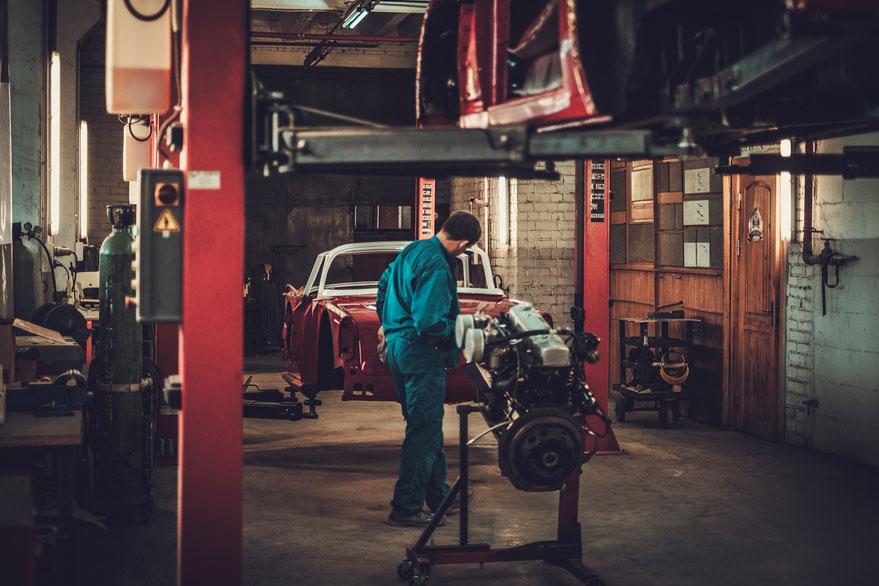
In workshops and garages across the UK, we often see declared cover that wouldn’t come close to replacing the tools of half a dozen mechanics. Tools are the lifeblood of your business – without them, work grinds to a halt. Insuring them is simple and affordable, yet theft remains one of the biggest risks for motor trade businesses.
Why? Because tools are portable, easy to sell, and almost impossible to trace once stolen.
Here are some practical tips to help you:
Make sure you have enough cover
Safeguard your tools as much as possible
Ensure any claim is settled quickly and fairly with minimal disruption
Top tips for protecting your tools
These aren’t conditions – just helpful hints from years of experience:
Include everything in your inventory Your policy may refer to “portable hand tools” – this includes electric tools like drills and grinders. Make sure they’re listed.
Secure toolboxes to the building Use heavy-duty chains and padlocks, and fix them to a solid wall or steel beam for maximum security.
Lock the toolbox It sounds simple, but anything that slows down a thief helps.
Use vehicles as barriers Park cars or vans to block access to toolboxes, making removal harder.
Keep invoices and receipts Proof of ownership speeds up claims. If you don’t have receipts, start keeping them right now.
Take photos Photograph each toolbox and its contents. Store images safely – they’re invaluable for claims.
Remember: boxes are covered too Not just the contents. Factor this into your declared value.
Get help calculating replacement values Your tool supplier can advise on current prices – and they’ll likely be the one replacing stolen tools.
Record specialist tools separately Document details, photos, and values for anything unique or high-value.
Factor in “new for old” cover Replacement costs today are higher than they were 10 years ago. Review your sums insured regularly.
What about employees’ tools?
We often hear: “They’re the mechanic’s own tools.” That’s fine – but if they’re kept at your workshop, they’re unlikely to be insured elsewhere. And no, they won’t be covered under household insurance – especially if a toolbox and contents are worth £20,000 or more.
You can choose to cover only tools owned by your business, but consider the impact of a burglary where employees’ tools aren’t insured. How will they be replaced? What happens if staff can’t afford new ones? The knock-on effect on your business could be huge.
Why this matters
We know how vital tools are to your business. Losing them means downtime, lost revenue, and unhappy customers. At Howden Classic Motor Trade, we understand your risks and can help you:
Arrange the right level of cover
Review your sums insured
Keep your business moving if the worst happens
For expert advice and a no-obligation review, call the Howden Classic Motor Trade team on 01252 888 546.
If you’ve ever spotted the term “subrogation waiver” (sometimes shortened to sub waiver or waiver of subrogation) in your insurance documents and wondered what it means, you’re not alone. It’s a technical term that plays a big role in how claims are handled – especially in the classic motor trade sector, where vehicles can be worth millions.
Let’s break it down.
What is subrogation?
Subrogation is the process that allows an insurer to recover money from a third party who caused damage. Here’s how it works:
Your insurer pays out for a claim
If someone else was responsible for the damage, your insurer can pursue them (or their insurer) to recover what they paid you
This protects insurers – and ultimately policyholders – because it helps keep premiums lower and ensures claims are settled quickly.
So, what is a subrogation waiver?
A subrogation waiver is an agreement that prevents your insurer from trying to recover money from a third party after paying your claim. In other words, your insurer gives up their right to seek reimbursement.
If you sign a waiver of subrogation, you’re agreeing that your insurer cannot pursue the party at fault – even if they were negligent.
How does it work in practice?
Imagine this scenario:
You’re involved in a car accident, and the other driver is at fault
Their insurer wants to settle directly with you, without involving your insurer
They ask you to sign a waiver of subrogation
If you sign, your insurer cannot recover costs from the other party. This might sound harmless, but it can have serious consequences for your policy and claims record.
Why would an insurer object?
Insurers rely on subrogation to recover costs when they pay out on claims that weren’t your fault. For example:
You prefer to deal with your own insurer for repairs
Your insurer pays upfront, then recovers costs from the negligent party
This process often reimburses your excess too
If you sign a waiver, your insurer loses that right – and you could end up with a claim on your record that might have been recoverable.
Why might you be asked to sign one?
In the motor trade, waivers often come up when:
A customer’s insurer wants to avoid involving your insurer
A garage or third party wants to simplify settlement
Howden’s advice
First and foremost, think very carefully before agreeing. Most of the time, it’s not in your best interest. Always speak to your insurer first – signing without consent could even void your policy.
At Howden Classic Motor Trade, we deal with these situations every day. Our team can:
Explain what a waiver means for your business
Review your insurance terms and any proposed agreements
Ensure you stay protected and compliant
It’s our business to protect your business – and make complex insurance simple.
Call our Classic Motor Trade team on 01252 888 546 for a no-obligation review.
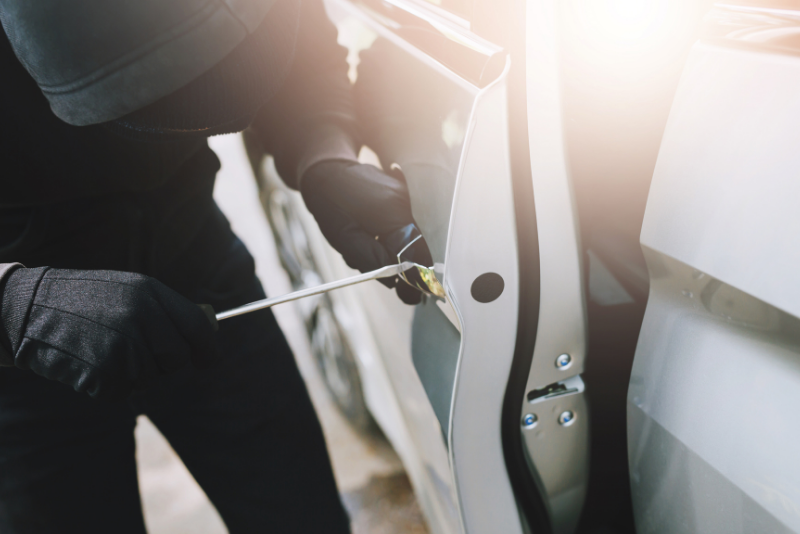
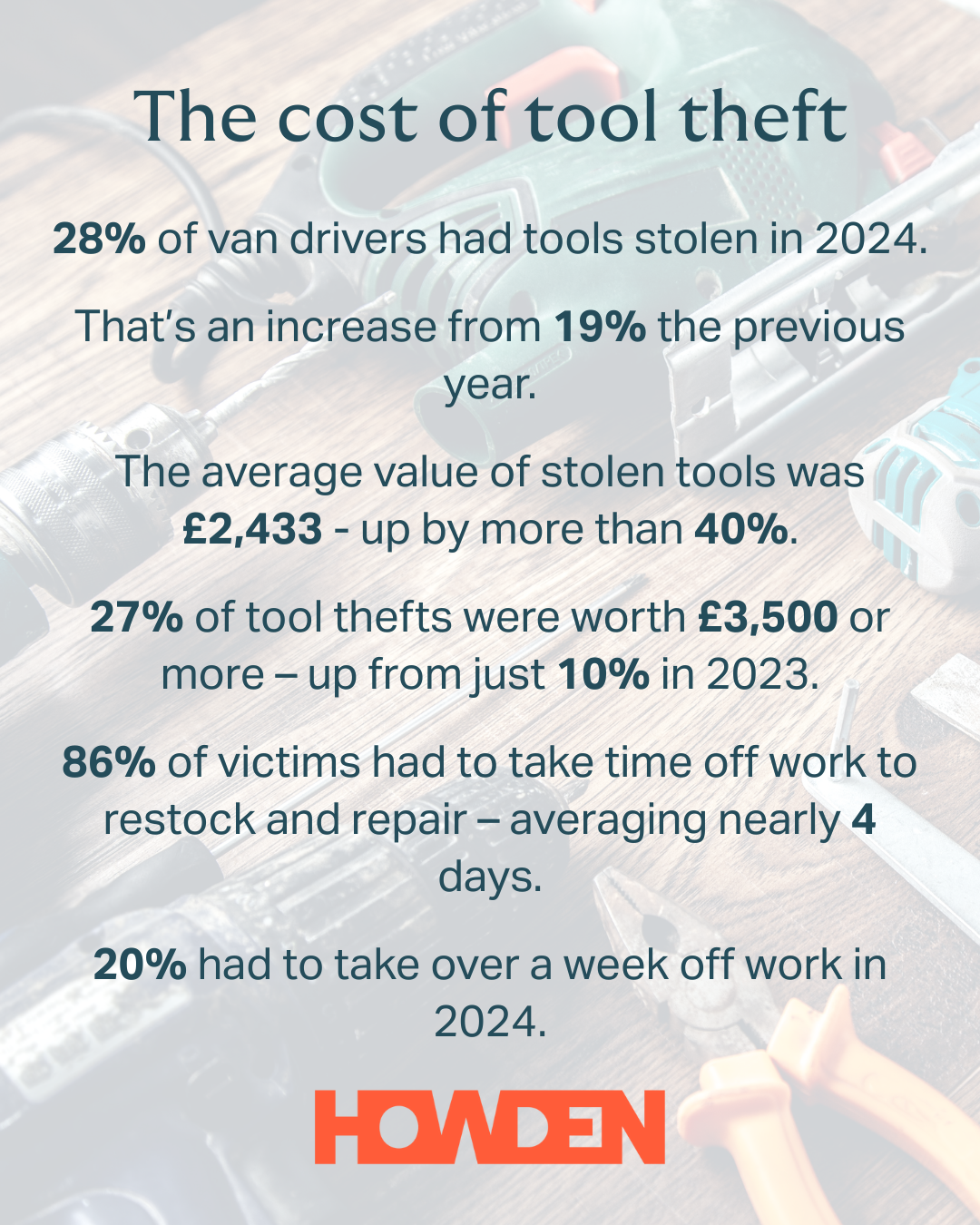
Let’s not sugar-coat it: tool theft is out of control. If you’re a van driver, chances are you’ve either been hit by it or know someone who has. In 2024 alone, more than a quarter of UK van drivers had their tools nicked – that’s up from just under a fifth the year before. And it’s not just the number of thefts that’s climbing. The value of stolen gear has shot up by over 40%, with the average loss now sitting at a painful £2,433.
That’s not just a few screwdrivers and a drill. That’s your livelihood.
The real cost of tool theft
It’s not just about replacing your kit. It’s the downtime. The stress. The missed jobs. The awkward calls to clients. The scramble to borrow gear or cancel work. Most victims of tool theft in 2024 had to take nearly four days off work to sort things out. One in five were off for more than a week.
And let’s be honest, when you’re self-employed or running a small business that kind of disruption hits hard. It’s not just lost earnings. It’s lost trust. Lost momentum. And for some, it’s a tipping point into serious financial trouble.
New law, new hope?
A new law has landed, and it’s aiming to treat tool theft like the serious crime it is. Judges now have to consider the full impact on victims – not just the cost of the tools, but the mental health toll, lost earnings, and business disruption.
Stronger community controls: probation services can enforce restriction zones to keep repeat offenders away from building sites and tool hotspots.
Tougher community sentences: think bans on driving, pub visits, and events, so that there’s a real impact.
Intensive Supervision Courts to deal with serial offenders who target multiple trades across wide areas.
It’s a step in the right direction. But let’s be real, laws take time to bite. Especially as tool thieves still have to be caught in the first place to be prosecuted.
Peak tool theft season is here
Met Police data shows winter is prime time for tool theft. Shorter days, darker mornings, longer nights – it’s a thief’s dream. But don’t let the sunshine lull you into slacking off. Tool thieves don’t take holidays.
So what can you do?
Here’s the no-nonsense advice:
Lock it down: Invest in van locks, tool safes, and security systems. The more hassle it is to nick your gear, the more likely thieves will move on.
Park smart: Well-lit areas, busy streets, and CCTV coverage are your friends.
Mark your tools: UV pens, engraving, or smart tech like GPS tags can help recover stolen gear and prove ownership.
Don’t leave tools in the van overnight: It’s a pain, but it’s better than waking up to an empty van.
Get insured: If your tools are your income then insurance isn’t a luxury, it’s a lifeline.
Tool insurance: worth every penny
Tool insurance isn’t mandatory, but it’s a no-brainer. If your gear gets stolen, damaged, or lost, a good policy can get you back on the job fast with minimal faff.
Yes, some van insurance policies offer tool cover as an add-on. But don’t assume it’s included, check the small print. If it’s not there, add it. If it is, make sure the cover limit actually matches the value of your kit.
Ask yourself: could you afford to replace your tools tomorrow? If the answer’s no, then tool insurance is your safety net.
Don’t wait until you’re a statistic
Tool theft is rising. The laws are changing. But the best defence is still you. Be proactive. Be prepared. And don’t let thieves take more than your tools: don’t let them take your business, your income, or your peace of mind.
The UK funeral sector is entering a period of significant regulatory change. For funeral directors, staying informed and prepared is essential to ensure compliance, protect families, and safeguard business reputation. Here’s an overview of the key developments shaping 2026 and beyond.
Towards statutory regulation
The government is moving closer to formal oversight of funeral services.
Following the Fuller Inquiry in 2025, the Ministry of Justice has committed to introducing statutory regulation for funeral directors, with a full response expected by summer 20261
This marks a shift away from voluntary self‑regulation, ensuring consistent standards across the sector
Funeral directors should anticipate new licensing requirements and mandatory adherence to professional codes of conduct
Standards and transparency
Clearer rules will strengthen trust between families and providers.
The Ministry of Justice has outlined a roadmap to assess the adequacy of current self‑regulation and gather evidence on future frameworks2
Pricing transparency remains a priority, with expectations that funeral directors provide clear, upfront information to families
Independent oversight will likely enforce compliance, reducing the risk of misrepresentation or hidden costs
Emerging funerary methods
Law reform is catching up with modern practices.
The Law Commission has highlighted outdated burial and cremation laws, noting the need to regulate new funerary methods such as resomation (water cremation) and natural organic reduction3
Future legislation aims to ensure families’ wishes are respected while providing clarity on rights and responsibilities
Funeral directors should prepare to advise families on these evolving options once regulations are in place
Funeral plans oversight
Financial Conduct Authority (FCA) regulation continues to shape prepaid plans.
Since 2022, prepaid funeral plans have been regulated by the FCA, requiring providers and intermediaries to be authorised4
Funeral directors selling plans must ensure compliance, either through direct authorisation or as appointed representatives
This protects consumers and reinforces trust in long‑term planning
Supporting families, safeguarding your business
Regulation in the funeral sector is evolving rapidly, with statutory oversight, transparency requirements, and new funerary methods all on the horizon. Funeral directors who stay ahead of these changes will be best placed to reassure families and protect their businesses.
At Howden, we make sure your funeral business is protected, so you can focus on guiding families with care – confident that your cover supports you through regulatory change.
In the chauffeur industry, reputation is everything. Clients choose you because they trust you with their time, their safety, and often their privacy. But in a world where bookings, payments, and client details are increasingly handled online, that trust now extends far beyond the vehicle.
Cybersecurity has become a critical part of running a modern chauffeur business – and protecting your booking systems is at the heart of it.
Why chauffeur businesses are becoming cyber targets
Chauffeur companies, whether sole traders or large fleets, hold exactly the kind of data cybercriminals look for:
Client names and contact details
Travel itineraries
Payment information
Corporate account details
High‑profile or VIP client movements
Even small operators can be targeted. In fact, smaller businesses are often seen as easier entry points because they may not have dedicated IT support or robust security in place.
The risks to your booking systems
1. Booking system breaches
If your online booking platform is compromised, attackers could access client data, alter bookings, or lock you out entirely.
2. Ransomware attacks
Cybercriminals can encrypt your systems and demand payment to restore access – leaving you unable to take bookings or dispatch drivers.
3. Phishing and impersonation
Fake emails or messages can trick staff into revealing passwords or clicking malicious links, giving attackers access to your systems.
4. Data loss and reputational damage
A breach doesn’t just disrupt operations – it can seriously damage client trust, especially if you work with corporate accounts or high‑profile individuals.
How to strengthen your cybersecurity
1. Use secure, reputable booking software
Choose platforms with strong security features, regular updates, and two‑factor authentication. Avoid outdated or unsupported systems.
2. Protect your devices
Drivers often use phones or tablets for bookings and dispatch. Make sure devices are:
Human error is one of the biggest cyber risks. Make sure staff know how to:
Spot phishing emails
Avoid suspicious links
Handle client data safely
Report anything unusual
4. Back up your data
Regular backups mean you can recover quickly if your system is compromised.
5. Use strong, unique passwords
And change them regularly. Password managers can help keep things secure and simple.
Why cyber insurance matters for chauffeur businesses
Even with strong security, no system is completely risk‑free. Cyber insurance can help protect your business from the financial and operational impact of an attack, including:
System restoration costs
Data recovery
Business interruption losses
Legal and regulatory support
Client notification and crisis management
For chauffeur businesses that rely heavily on digital bookings and client trust, this protection can be invaluable.
Howden’s support for chauffeur operators
At Howden, we understand that your booking system is the engine of your business. Our specialist chauffeur team can help you assess your cyber risks and explore cover options designed to keep your business running smoothly – even when the unexpected happens.
A secure business is a trusted business. And in the chauffeur world, trust is everything.
When the fields turn soggy and gateways resemble puddles, mud fever becomes a real headache for horse owners. This skin condition can cause discomfort, swelling, and even lameness if left unchecked. So, how do you keep your horse’s legs safe when winter brings endless mud?
What is mud fever?
Mud fever, also known as pastern dermatitis, is a non-contagious skin infection that usually affects the lower legs. It starts when the skin’s natural barrier breaks down, allowing bacteria to invade. Typical signs include:
Scabs and crusty patches
Hair loss around the pastern or fetlock
Oozing discharge
Heat, swelling, and sometimes lameness
Although most cases appear on the legs, similar infections can occur on other parts of the body, often called rain scald.
Why prevention matters
Wet, muddy conditions soften the skin, making it vulnerable to bacteria. Horses with white legs, fine skin, or compromised immunity are particularly at risk. Add in mites or fungal infections, and the problem can escalate quickly. Preventing mud fever is far easier than treating it, and it saves your horse from unnecessary discomfort.
Practical prevention strategies
1. Manage turnout conditions
Rotate grazing areas to avoid poached fields.
Lay hardcore or rubber mats in high-traffic spots like gateways and around water troughs.
Fence off deep mud patches to reduce exposure.
2. Daily leg care
Don’t scrub legs every time they’re muddy. Let mud dry and brush it off gently.
If washing is unavoidable, use lukewarm water and dry thoroughly with a clean towel.
Check legs daily for scabs or irritation so you can act early.
3. Protective measures
Apply barrier creams before turnout, but only on clean, dry skin.
Consider turnout boots for extra protection, ensuring they fit well and don’t rub.
Clip feathers if they trap mud and moisture but do so carefully to avoid nicks.
4. Address underlying issues
Treat mites or fungal infections promptly.
Support immune health with balanced nutrition and good management practices.
Extra tips for winter management
Keep stables well-bedded and dry.
Avoid harsh grooming or excessive washing, which can strip natural oils.
Use electric fencing to keep horses out of deep mud.
Consider supplements that promote healthy skin and coat.
When to call the vet
If scabs worsen, swelling develops, or your horse becomes lame, it’s time to seek veterinary advice. Untreated mud fever can lead to serious complications like cellulitis or lymphangitis, so don’t delay.
Conclusion
Preventing mud fever is all about reducing wet exposure, gentle leg care, and staying vigilant. A few small changes to your winter routine can make a big difference to your horse’s comfort and health.
Protect your horse with the right cover
Even with the best care, unexpected vet bills can happen. Having the right equine insurance means you can act quickly without worrying about costs. At Howden, we offer tailored horse insurance that covers veterinary fees, accidental injuries, and more.
Discover our equine insurance options today and give your horse the protection they deserve by calling the team on 01743 455911 or getting a quote here.
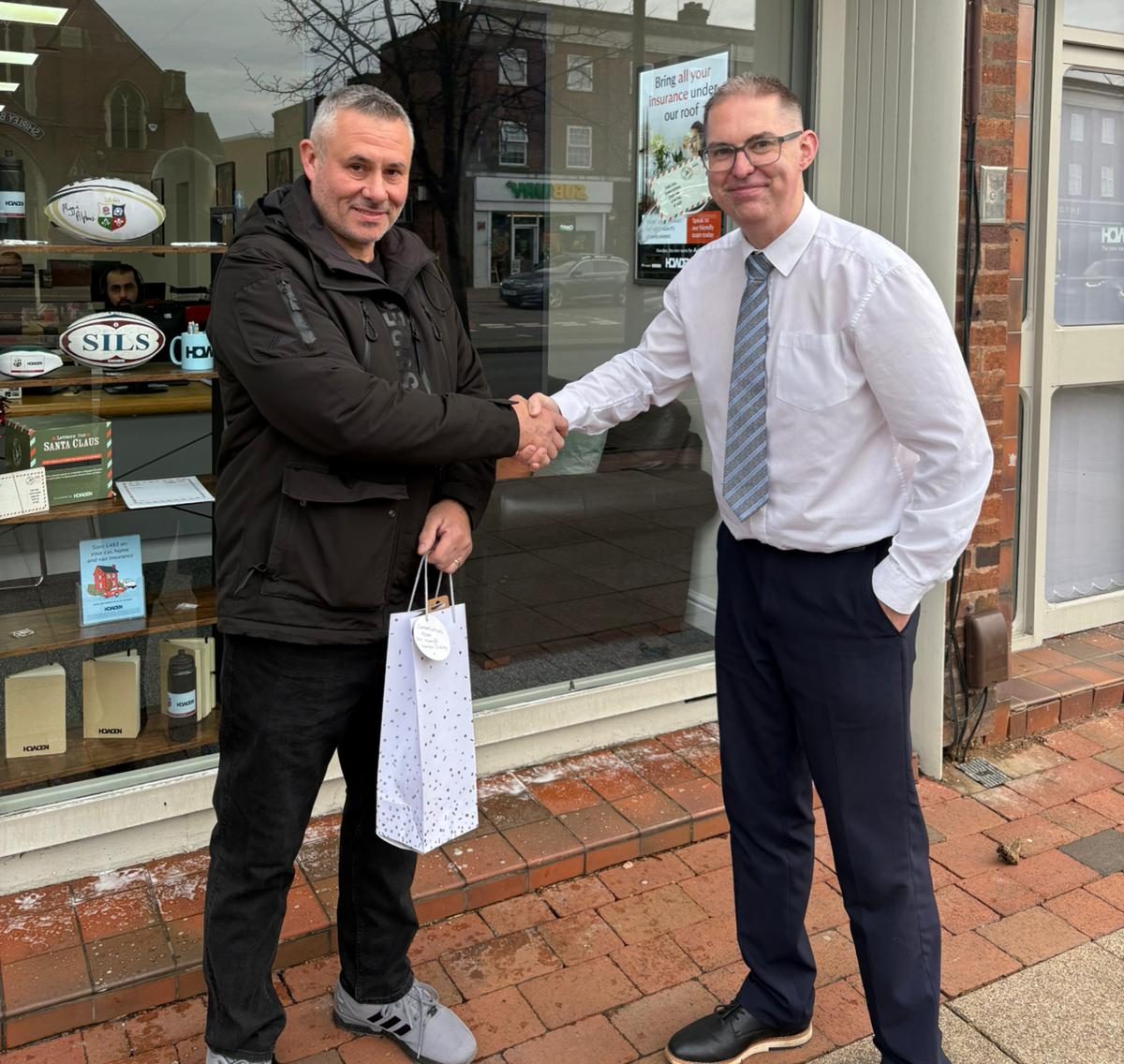
We’ve picked our January Monthly Newsletter Prize Draw winner at random, and this month’s winner is Mrs Georgina Dominy, from Fareham!
Congratulations Mrs Dominy and thank you for choosing Howden!
Our newsletter prize draw has now been running since 2020 – and we’ve given 62 clients their premiums back. Keep a look out each month, as it could be you next time.
December 2024 winner Mr Ian Brown with Shirley Assistant Branch Manager Carl Nixon
July 2025 winner Mrs Nikki Glover and Assistant Branch Manager Lee McCann
Our February 2024 winner Mr Stephen Baker with Peterborough Branch Manager Jose Meneses!Our July 2024 winner Mrs Julie Damon with Eastleigh Client Service Manager John Chapman!
Terms and Conditions
1. The Promoter
The promoter is: A-Plan Holdings T/A Howden
2. The Competition
2.1 The title of the prize draw is ‘Win back your premium’.
2.2 To enter, you must have opted in to receive Howden email marketing communications and have a minimum of one live policy that has been active for longer than 30 days. You must agree to these T&Cs.
3. How to Enter
3.1 The monthly prize draw will run from 09.00 on the 2nd of each month (the “Opening Date”) to 17.00 on the 25th of each month (the “Closing Date”) inclusive.
3.2 To enter the monthly prize draw:
(a) You must:
(i) Be opted in to receive email marketing communications (but can choose to opt out at any time).
(ii) Agree to these T&Cs.
(iii) Accept the privacy policy.
(iv) Hold a live policy that has been active for longer than 30 days with the Promoter at the competition Closing Date.
3.3 No purchase is necessary, and there is no charge to register for use of the website.
3.4 The Promoter will not accept:
(a) Responsibility for competition entries that are lost, mislaid, damaged, or delayed in transit, regardless of cause, including, for example, as a result of any postal failure, equipment failure, technical malfunction, systems, satellite network, server, computer hardware, or software failure of any kind.
(b) Proof of posting or transmission as proof of receipt of entry to the competition.
4. The winner will be chosen by a random number generator.
4.1 The competition is only open to all residents in England and Wales aged 18 years or over, except:
(a) Employees of the Promoter or its holding or subsidiary companies;
(b) Employees of agents or suppliers of the Promoter or its holding or subsidiary companies who are professionally connected with the competition or its administration; or
(c) Members of the immediate families or households of (a) and (b) above.
4.2 In entering the competition, you confirm that you are eligible to do so and eligible to claim the prize you may win. The Promoter may require you to provide proof that you are eligible to enter the competition.
4.3 There is a limit of one entry per entity, and a client may only win once in a 12-month period. Entries on behalf of another person will not be accepted, and joint submissions are not allowed.
4.4 The Promoter reserves all rights to disqualify you if your conduct is contrary to the spirit or intention of the prize competition.
5. The Prize
5.1 The prize is for one winner to have their insurance premium refunded (including optional extras and fees) up to the value of £500 and only one is available to be won.
5.2 If the client has more than one live policy, the refund applies to the policy with the highest premium that has been live for over 30 days.
5.3 The prize is not negotiable or transferable.
6. Winners
6.1 The decision of the Promoter is final, and no correspondence or discussion will be entered into.
6.2 The Promoter will contact the winner personally as soon as practicable after the Announcement Date, using the telephone number or email address provided with the competition entry. The Promoter will not amend any contact information once the competition entry form has been submitted.
6.3 If you object to any or all of your surname, county, and winning entry being published or made available, please contact the Promoter Howden, 2 Des Roches Square, Witney, OX28 4LE. In such circumstances, the Promoter must still provide the information and winning entry to the Advertising Standards Authority on request.
7. Claiming the Prize
7.1 Please allow 14 days for delivery of the prize.
7.2 The prize may not be claimed by a third party on your behalf.
7.3 The Promoter will make all reasonable efforts to contact the winner. If the winner cannot be contacted or is not available, or has not claimed their prize within 30 (thirty) days of the Announcement Date, the Promoter reserves the right to offer the prize to the next eligible entrant selected from the correct entries that were received before the Closing Date.
7.4 The Promoter does not accept any responsibility if you are not able to take up the prize.
8. Limitation of Liability
Insofar as is permitted by law, the Promoter, its agents, or distributors will not in any circumstances be responsible or liable to compensate the winner or accept any liability for any loss, damage, personal injury, or death occurring as a result of taking up the prize, except where it is caused by the negligence of the Promoter, its agents, or distributors, or that of their employees. Your statutory rights are not affected.
9. Ownership of Competition Entries and Intellectual Property Rights
9.1 The Promoter does not claim any rights of ownership in your competition entry.
10. Data Protection and Publicity
10.1 The Promoter will only process your personal information as set out in the Promoter’s Privacy Policy. See also condition 6.2 and condition 6.3 with regard to the announcement of winners.
11. General
11.1 If there is any reason to believe that there has been a breach of these terms and conditions, the Promoter may, at its sole discretion, reserve the right to exclude you from participating in the competition.
11.2 The Promoter reserves the right to hold void, suspend, cancel, or amend the prize competition where it becomes necessary to do so.
11.3 These terms and conditions shall be governed by English law, and the parties submit to the non-exclusive jurisdiction of the courts of England and Wales.
As 2025 draws to a close and the festive season begins, it’s time for one of our favourite traditions: looking back at the cars that have taken their final bow. This year, the automotive world said goodbye to some true legends – from British icons to global favourites – all casualties of changing consumer tastes and the relentless march toward electrification. For UK drivers, collectors, and motor trade professionals, these departures mark a turning point in automotive history.
Why are so many cars disappearing?
The short answer: electrification and changing consumer habits. Governments across Europe, including the UK, have set ambitious targets for phasing out petrol and diesel cars, with 2035 looming as the deadline for new ICE (internal combustion engine) sales. Manufacturers are responding by streamlining lineups, cutting slower-selling models, and investing heavily in EV platforms. Add in the rise of SUVs and crossovers, and traditional coupes, saloons, plus niche models are increasingly squeezed out.
Farewell to UK icons and familiar faces
1. Jaguar F-Type – the end of British petrol performance
The F-Type’s departure is particularly poignant for UK enthusiasts. Since debuting in 2013, it’s carried the torch for Jaguar’s sports car heritage, offering a blend of elegance and raw performance, with its crackling V8 soundtrack becoming a hallmark of British motoring passion. With Jaguar committing to an all-electric lineup by 2025, the F-Type’s exit feels like the closing chapter of a glorious era. For collectors, this model is destined to become a future classic.
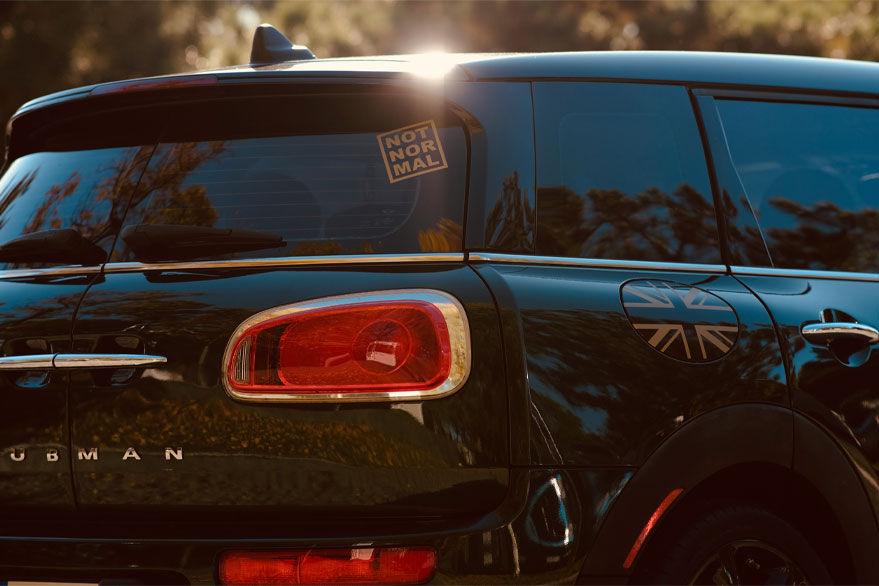
2. Mini Clubman – quirky charm bows out
The Clubman was never the biggest seller, but it created out a unique space among UK drivers who wanted something practical yet stylish. Its split rear doors and premium interior made it stand out in a crowded market. As Mini pivots toward EVs, the Clubman departs quietly, leaving fans nostalgic for its characterful design. Expect the next generation of Minis to be fully electric, with the brand doubling down on sustainability.
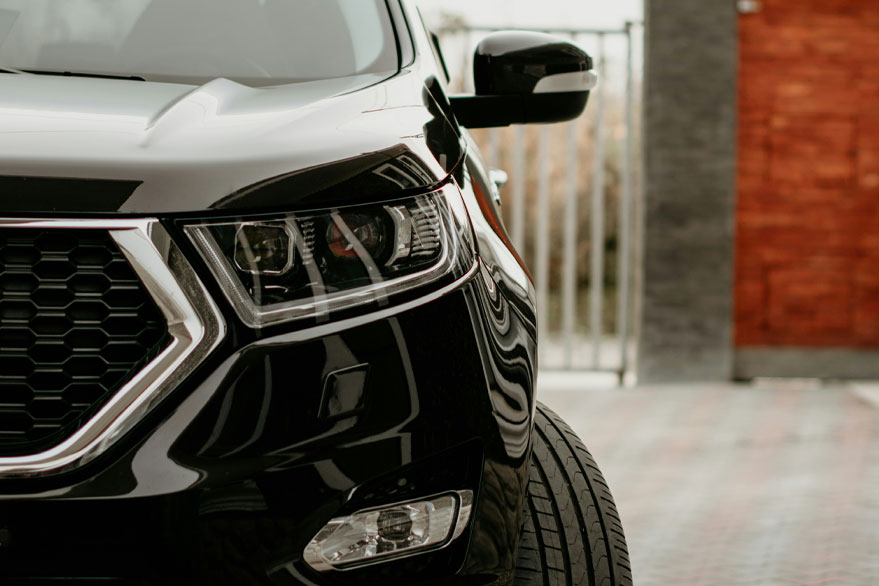
3. Ford Edge – a global SUV that never quite fitted
The Edge was a transatlantic import that found modest success in the UK. Larger than the Kuga but smaller than the Explorer, it appealed to families seeking space and comfort. However, as Ford focuses on EVs like the Mustang Mach-E and trims its global lineup, the Edge has been unable to justify its place. UK buyers will now look to electrified alternatives for their SUV needs.
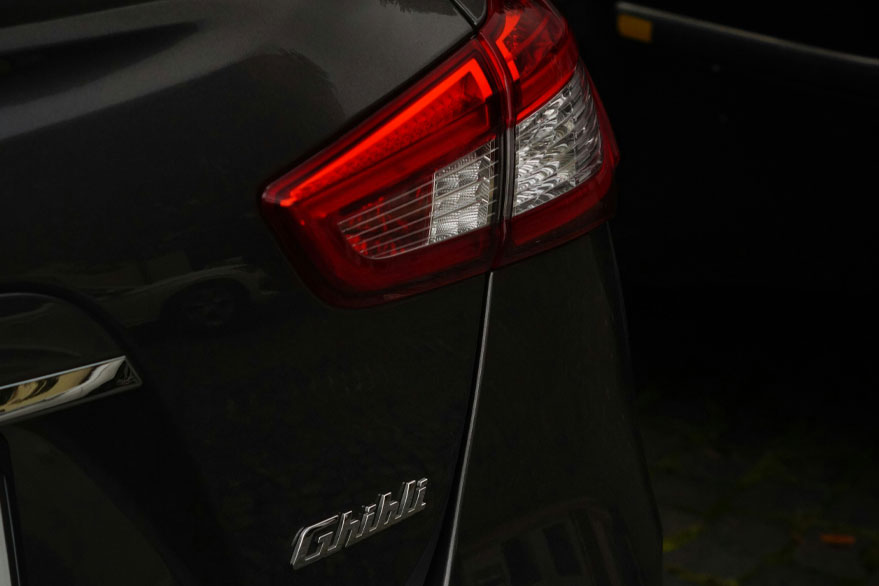
4. Maserati Ghibli – Italian elegance fades
The Ghibli brought Italian flair to UK roads, offering a slick, chic alternative to German saloons. Despite recent Trofeo performance variants, sales never soared. Maserati’s future lies in electrified luxury, with models like the GranTurismo Folgore leading the charge. For UK enthusiasts, the Ghibli’s exit signals the end of an era of petrol-powered Italian sophistication.
Global farewells that UK enthusiasts care about
Even if some of these models weren’t common on UK roads, they hold a special place in the hearts of collectors and performance fans:
Chevrolet Camaro – a muscle car legend adored by UK import fans. Its departure marks the end of petrol-powered American icons
Nissan GT-R – “Godzilla” had a cult following in the UK, thanks to its blistering acceleration and motorsport pedigree
Audi A5 Coupe & Cabriolet – popular among UK drivers for their elegance and performance, these two-door models can only be seen in the rear-view mirror as Audi transitions to EVs
Alfa Romeo Quadrifoglio (Giulia & Stelvio) – Enthusiast favourites with Ferrari-derived V6 engines, their exit marks a big shift for Alfa Romeo’s UK lineup
Chevrolet Malibu, Infiniti Q50, Mitsubishi Mirage – less common in the UK but notable globally as sedans and budget hatchbacks continue to disappear
What does this mean for UK drivers and the motor trade?
The pace of change is accelerating. For UK dealerships, brokers, and motor traders, these departures mean adapting to a market dominated by EVs and SUVs. For enthusiasts and collectors, it’s a reminder that petrol-powered icons are becoming rarer – and potentially more valuable.
If you own or trade any of these outgoing models, insurance and valuation strategies need to evolve. Classic and specialist cover is more important than ever, ensuring these vehicles remain protected as they transition from daily drivers to cherished classics.
Looking ahead
2026 will bring even more change, with manufacturers unveiling new EV platforms and phasing out remaining ICE models. For UK drivers, the challenge – and opportunity – lies in embracing this new era while preserving the passion for motoring heritage.
Need expert advice? Talk to our Classic Motor Trade team today for tailored quotes and cover that protects what drives your business.